
Mastering the Power8 - Hypnotic Induction


It is often useful to explain that while these inductions are usually seen on a stage or street performance, there is a distinct difference between "Entertainment Hypnosis" (e.g., stage) and "Clinical Hypnotherapy."
Mastering the Power8: The Complete Guide to the Rapid Hand Drop Induction
Few hypnotic inductions are as iconic, reliable, or lightning-fast as the classic hand drop technique. Known as the Power8 (or 8-word technique), this rapid shock induction combines kinaesthetics and a verbal entry into trance with eight punchy words across three commands:
"Press on my hand." (4 words)
"Close your eyes." (3 words)
"Sleep!" (1 word)
Popularised by modern hypnotists, the Power8 bypasses critical analytical resistance by pairing sudden physical feedback with an instinctive startle reflex.
The Mechanics Behind the Induction
The Power8 works through kinetic leverage rather than elaborate persuasion:
Sensory Narrowing: Maintaining physical resistance while shutting off vision forces the conscious mind to reorient inward.
Vestibular Shock: Removing physical support causes an unexpected drop. That microsecond of falling opens a critical psychological doorway before conscious evaluation can step in.
Direct Suggestion: The single-syllable command lands inside that momentary cognitive vacuum, translating directly into immediate neural relaxation.
Step-by-Step Execution Guide
Step 1: Set the Baseline
Seat the subject safely in a stable, comfortable chair. Ensure their feet are grounded and posture is supported. Offer an upturned palm at roughly mid-chest height.
Step 2: Command Resistance (4 Words)
Direct the client: "Press on my hand." Match their downward pressure, providing a steady, solid shelf of resistance so their shoulder and forearm muscles remain fully engaged.
Step 3: Remove the Visual Anchor (3 Words)
While keeping firm upward resistance against their palm, state calmly: "Close your eyes." Wait a single beat until their eyelids fully settle while they continue applying downward force.
Step 4: The Drop & Shock Command (1 Word)
Without warning or flinching, swiftly pull your supporting hand down and out to the side. As their arm drops through empty space, deliver the command with firm, resonant authority: "Sleep!"
Step 5: Catch, Stabilise, and Deepen
Never leave the client hanging in a startle response. The instant the arm drops, place a stabilising hand gently behind the back of the neck or on the shoulder. Pair this physical anchoring with immediate deepening suggestions: "Dropping ten times deeper with every breath out... letting every muscle let go completely."
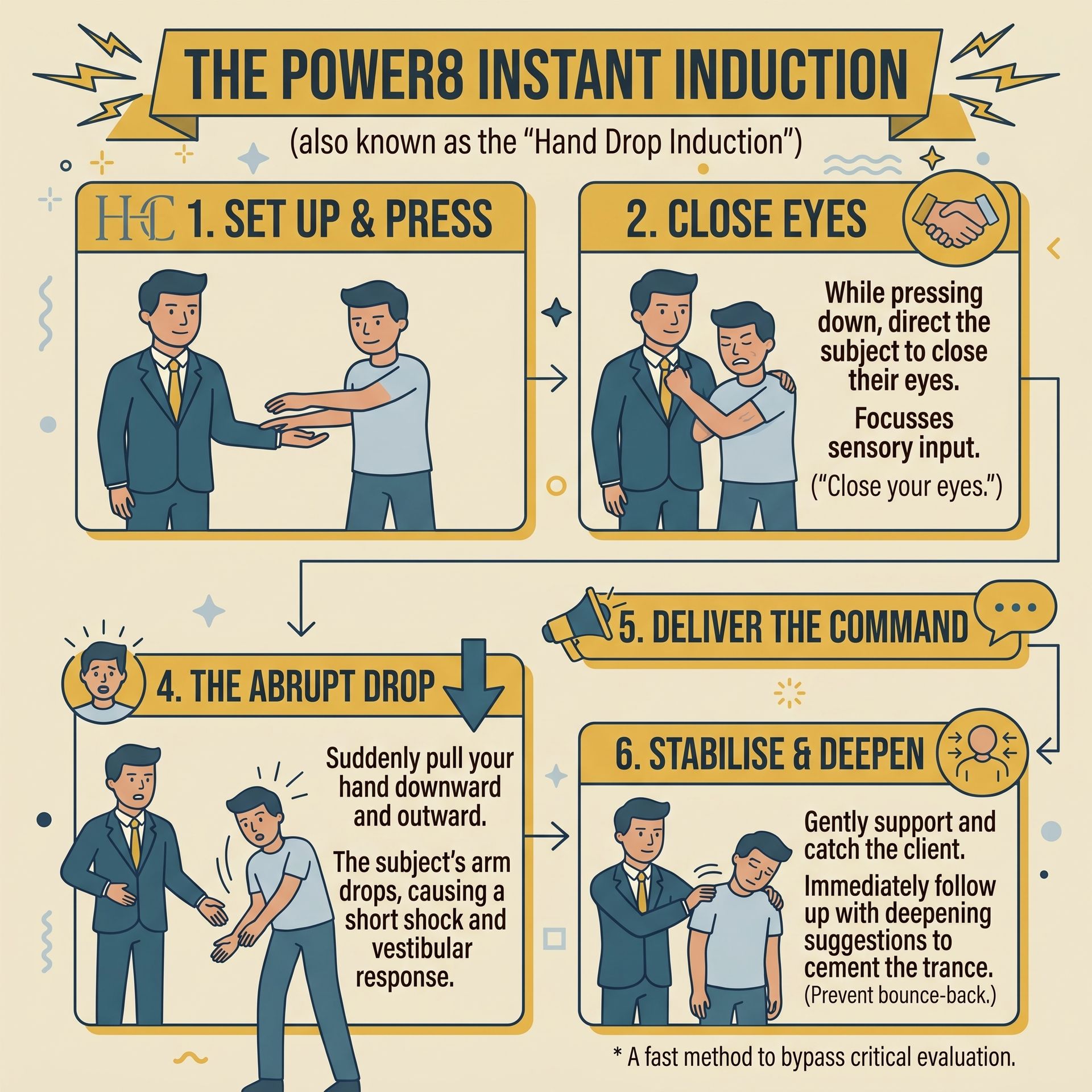
The rapid inductions often used in stage shows are intentionally chosen for speed, dramatic effect, and to create an immediate "wow factor" that ensures audience engagement. However, for a trained clinical hypnotherapist, a rapid induction can be an incredibly powerful tool utilised for different reasons.
The Benefits of Rapid Inductions in a Clinical Setting
Rather than performance, a clinical hypnotherapist will use a rapid induction for several key reasons:
Efficiency and Optimal Time Use: There is a distinct difference between "Entertainment Hypnosis" (e.g., stage) and "clinical hypnotherapy". The clinical practice is to reach a therapeutic depth of trance quickly and efficiently. Sometimes, by spending less time on the induction process, the hypnotherapist can maximise the valuable session time available for the important therapeutic work.
Effective with Analytical or Sceptical Clients: Rapid inductions can be particularly effective with highly analytical or naturally sceptical individuals. The quick and unexpected nature of the shock or confusion will temporarily suspend their critical factor (the analytical part of the brain). This unique bypass mechanism allows the suggestions to be received more directly.
Building Client Confidence and Belief: For clients who may be struggling with belief in hypnosis or their own "susceptibility", a fast and obvious response, like a complete physical drop, can build profound confidence. The clear demonstration that they are indeed "in hypnosis" can strengthen the client-therapist rapport and enhance their receptivity to the subsequent therapeutic work.